
One patient record. Five roles. Zero manual handoffs.
- Client
- MedMetrics
- Industry
- Healthtech · Clinical Management · Practice Operations
- Scope
- Web app · Five role-based dashboards · AI clinical workflows
- Year
- 2026
- Lumixel role
- Industry research · workflow analysis · architecture + design
The problem — The average outpatient clinic runs on eight disconnected tools. A single patient visit passes through six or seven separate interfaces: booking, check-in, chart, ECG, imaging, and pharmacy. None share a live view of the patient's status. Physicians spend two hours on admin for every hour of care; 63% report burnout. Most diagnostic errors happen not because information is missing, but because it isn't visible at the right moment, in the right system, to the right person.
The outcome — MedMetrics replaces those eight tools with one patient record and five role-filtered surfaces. A vitals flag, a lab result, and a prescription all propagate live across roles. No phone call in between. AI Scribe writes the note during the visit. AI imaging flags stay transparent and overridable. The admin dashboard surfaces operational risk in real time, not at the end of the day.
Context
Healthcare software was built by departments, not around the patient journey. KLAS reports clinics run on ~8 separate tools daily; the slowness is architectural, not human.
The clinical cost: BMJ estimates 40,000–80,000 annual US deaths tied to diagnostic errors, most occurring in the gaps between disconnected systems.
AI arrived fast (521 FDA-cleared AI devices by 2023, mostly radiology) but lives in separate portals. It accelerates one step while adding friction to three others. The problem is integration, not capability.
The approach — Decisions first. Execution scoped from those decisions.
Phase 01
Principles
Four constraints that shaped every surface before execution began.
- 01
Role-first, not feature-first
Every surface designed from the role's primary question outward, not from the data model inward.
- 02
Live status over manual communication
Clinical events propagate to every relevant role in real time; no role asks another what's happening.
- 03
AI as augmentation, not automation
Every AI action keeps the clinician in the decision loop: editable Scribe drafts, imaging flags with confidence + override path.
- 04
Documentation during, not after
Consultation, telehealth, and imaging review all produce documentation in the same interaction, never reconstructed from memory.
Phase 02
Execution
Five role-based dashboards designed against the same patient record: Doctor, Health Provider, Receptionist, Patient, and Admin.
Selected work — Visual proof across five clinical roles.
Key decisions — The trade-offs that shaped the work.
We considered
Separate patient-record modules per role (easier to scope).
We chose
One patient record; role determines which sections are visible, editable, and in what order. All five roles read the same underlying record.
Because
Fragmentation was the problem being solved. Role-scoped modules would rebuild it inside the platform. One record means a health provider's critical vitals flag shows up in the chart the doctor already has open. No separate notification from a separate system.
We considered
Separate patient-record modules per role (easier to scope).
We chose
One patient record; role determines which sections are visible, editable, and in what order. All five roles read the same underlying record.
Because
Fragmentation was the problem being solved. Role-scoped modules would rebuild it inside the platform. One record means a health provider's critical vitals flag shows up in the chart the doctor already has open. No separate notification from a separate system.
We considered
Note editor opens after the consultation ends (the standard EHR pattern).
We chose
The note editor is embedded in the consultation workspace; AI Scribe populates SOAP sections live; the doctor edits inline; the note is ready to sign the moment the visit ends.
Because
Post-visit documentation is the primary source of the 2:1 EHR time burden, and documentation from memory is slower and less accurate. This is the highest-leverage decision in the clinical surface.
We considered
Note editor opens after the consultation ends (the standard EHR pattern).
We chose
The note editor is embedded in the consultation workspace; AI Scribe populates SOAP sections live; the doctor edits inline; the note is ready to sign the moment the visit ends.
Because
Post-visit documentation is the primary source of the 2:1 EHR time burden, and documentation from memory is slower and less accurate. This is the highest-leverage decision in the clinical surface.
We considered
A binary AI imaging flag: red for a finding, nothing otherwise.
We chose
Three states (Finding Detected, Review Recommended, No Finding), each showing confidence level, scan region, model version, and an override path requiring a brief clinical note.
Because
Binary flags get clicked past (JAMIA puts alert override rates at 49–96%). Three states match actual clinical reasoning; the override note reduces inappropriate overrides without blocking legitimate ones.
We considered
A binary AI imaging flag: red for a finding, nothing otherwise.
We chose
Three states (Finding Detected, Review Recommended, No Finding), each showing confidence level, scan region, model version, and an override path requiring a brief clinical note.
Because
Binary flags get clicked past (JAMIA puts alert override rates at 49–96%). Three states match actual clinical reasoning; the override note reduces inappropriate overrides without blocking legitimate ones.
Outcome — What shipped.
8
Average separate tools a US outpatient clinic uses daily (KLAS, 2024)
63%
US physicians reporting burnout; administrative burden the leading cause (AMA, 2024)
40k–80k
Annual US deaths attributable to diagnostic errors (BMJ Quality & Safety)
MedMetrics is a single system where five roles act on one live patient record. AI assists without taking over the clinical decision. Documentation happens during the visit, not after. Operational risk is visible in real time, not at the end of the day. Built around the patient journey, not the org chart that usually shapes clinical software.
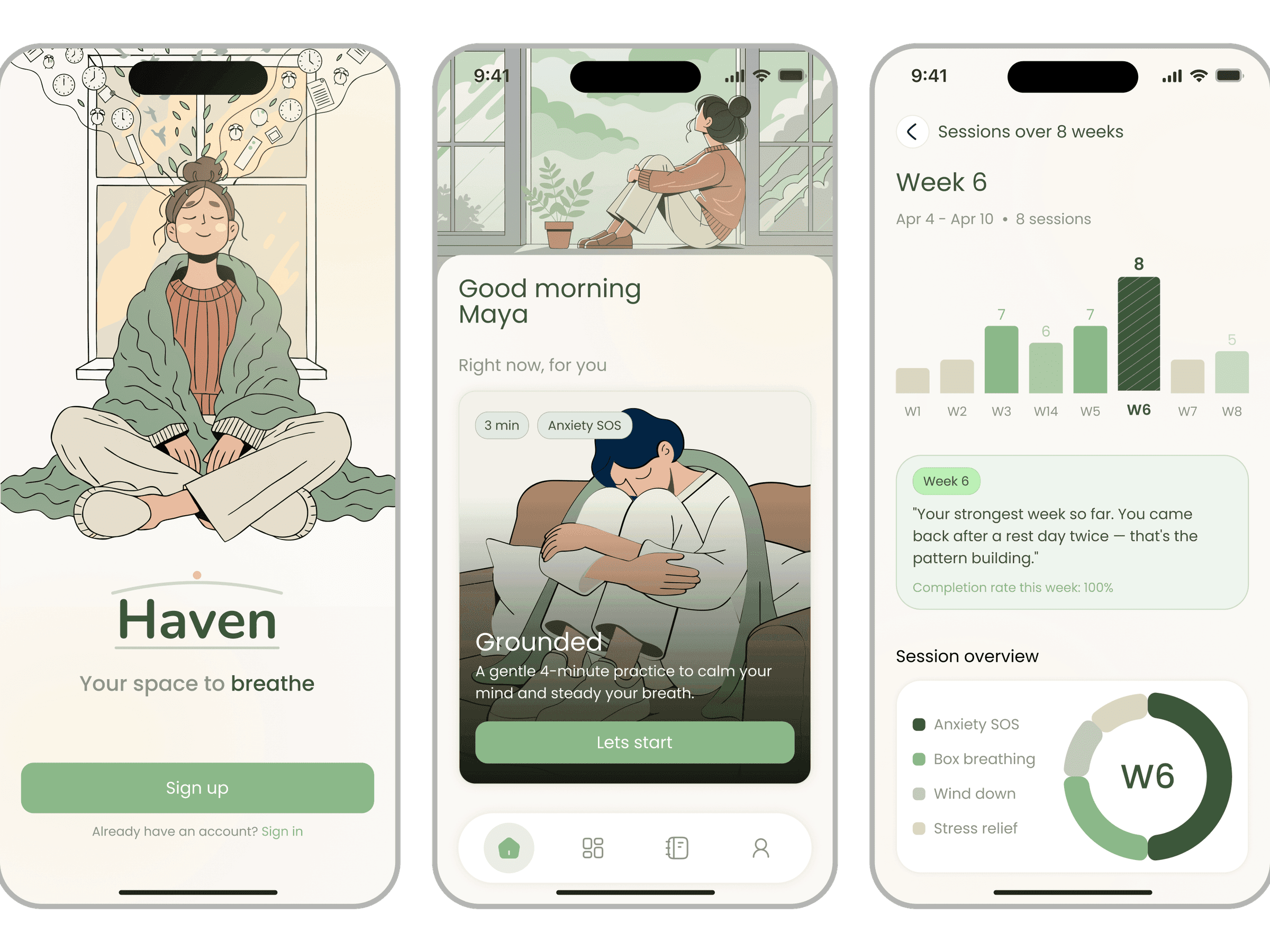
Next case study — Haven
A pre-launch iOS app with one Right Now card, a timeline that never resets, and Save for Later as the only exit.